
In this blog, Sonia writes about:
- Facilitating workshops at Brushstrokes Community Centre with Spectra
- These workshops were part of her photography project
- The workshops explored Maya. This is the illusion of separation between humans and nature
- In workshop 1, people made a big collage with photos, pens and a long roll of paper
- In workshop 2, people had a go at taking photos of each other and sharing their ideas
- In workshop 3, people made masks showing what separates or takes us away from nature
Reflections and photos by Sonia Bhamra
I had the privilege of co-facilitating a three-part series of creative workshops alongside Spectra at Brushstrokes Community Centre as part of the research and development phase of my photography project, The Illusions of Maya. The workshops were designed to explore the concept of Maya (Illusion) from Dharmic philosophy and ancient wisdom, the illusion of separation between humans and nature, through hands-on making, discussion, and collective reflection.

Across the series, the sessions moved progressively from open exploration to collaborative image-making to personal embodiment of ideas. This structure allowed participants to engage with the concept intellectually, emotionally, and materially, while also informing the development of my own artistic practice and mood board of ideas for the photographic essay.
Workshop One: Collage and Conversation
The first workshop was an introductory, collage-based session focused on opening up discussion around the idea of illusion and separation. Two long rolls of paper were set up down the centre of the room, surrounded by chairs, with collage materials, pens, and photo prints from my The Illusion of Separation photographic series laid out across the tables. This sparked great curiosity!
As participants arrived, they naturally began drawing, cutting, and responding to the images. Conversations emerged organically and were wonderfully varied. One man from Eritrea was drawn to a photograph of a boy wrapped in plastic lying in a green landscape. Working side by side with Ruby, he drew details from the image, particularly the oak tree partially obscured by plastic. This led to a conversation about forests in the UK and Eritrea, and he shared how long it had been since he had done anything creative.

Another participant from Afghanistan focused on the trees in the images and created a collage using textured paper. A non-verbal regular from the men’s group traced his hands in response to a photograph of melting ice, then carefully cut out images of carnivorous plants from a magazine and arranged them around his drawings. Another participant spoke with Ruby about the peace she finds at Edgbaston Reservoir. They talked about the fact that the reservoir was a place so many people visited and enjoyed being around, yet it was human-made yet natural space. This conversation further highlighted the complexity that resonated strongly with the theme of Maya. The session felt rich and expansive, full of dialogue, quiet reflection, and emerging ideas. It naturally pointed towards the next step: translating these reflections into photographic work.

Workshop Two: Photography and Interpretation
The second session shifted toward photography. Participants were introduced to using my professional camera alongside their phone cameras, keeping the process accessible and non-technical. The emphasis was on experimentation, play, and collaboration rather than technical perfection.
The room was rearranged to include a simple shooting station with a backdrop, alongside grouped tables filled with fabrics, plastics, natural materials, old electronics, and collage supplies. Participants could continue working on their collages or use them as inspiration before creating portraits of their faces or hands. Props were either selected or made by participants, allowing them to give form to their own interpretations of illusion using everyday materials.

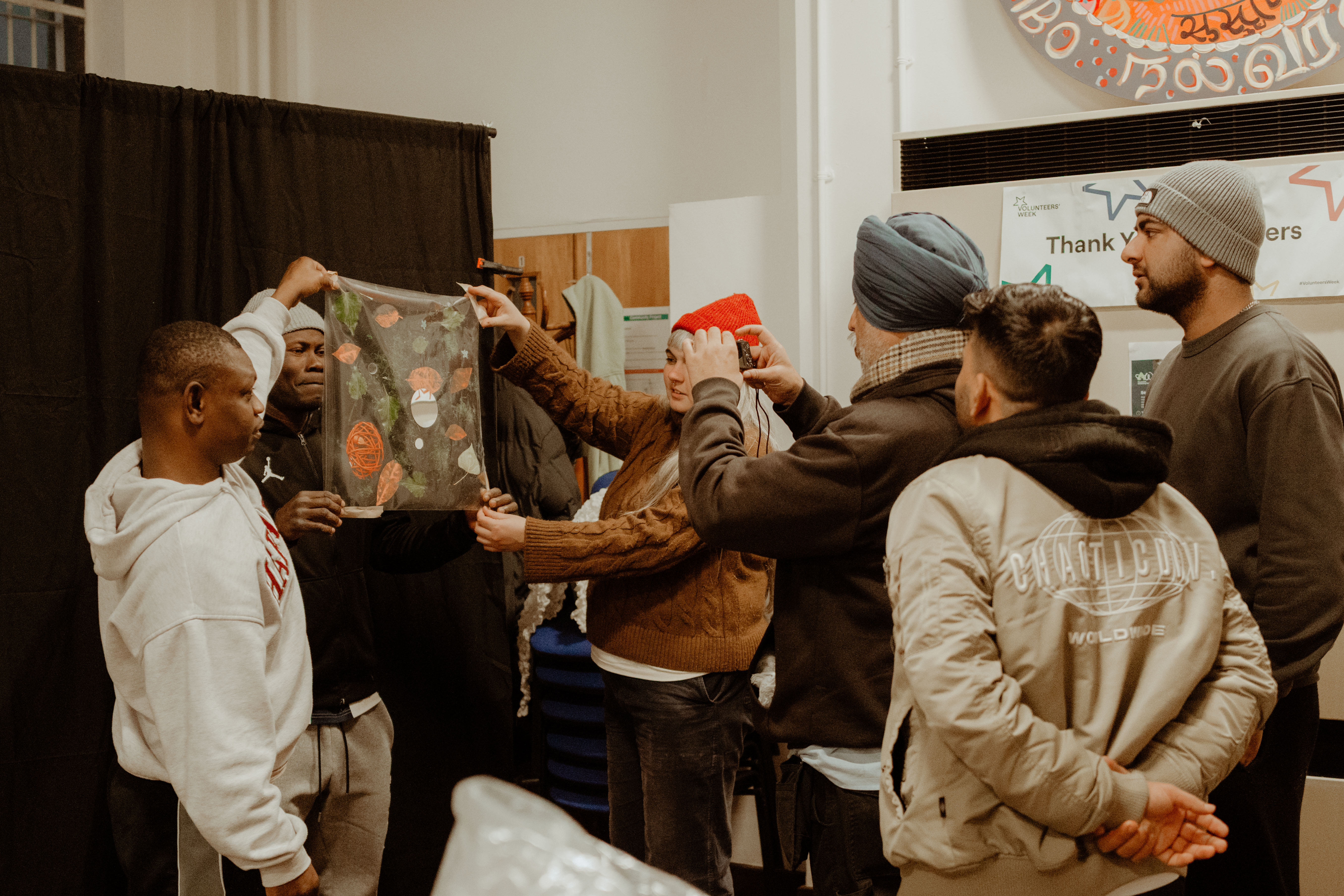
Some participants began by sketching ideas, while others explored materials directly, experimenting with posing and gesture with assistance from Ruby and Hayley. The atmosphere was very lively and collaborative, – as Bryan noted: “there was a real buzz during the session,” with participants photographing one another and sharing ideas. This session grounded the concept of Maya in something tangible and visual, making it an effective research and development tool.
Several participants engaged with the concept on a philosophical and spiritual level. One spoke about religion as an illusion while still believing in a higher power, describing Maya as a call to conscious action. Others connected the idea to Sikh teachings or broader philosophical frameworks. By the end of the session, participants felt less like subjects and more like collaborators, having actively shaped visual representations of illusion. This photographic approach has strong potential to be revisited and expanded in future workshops.
Workshop Three: Masks of Maya
The final workshop, Masks of Maya, took the exploration deeper and more inward. Building on the idea that Maya is the illusion separating us from nature, we focused on the “masks” of modern civilisation, forces such as pollution, extraction, consumption, and convenience that obscure our interconnectedness with the living world.
Stations were set up around the table, each focusing on a different force. I created an example mask responding to deforestation in advance of the session, while Ruby also made a mask using layered cardboard, mirrors, and fallen leaves. These examples inspired a participant from Iran, who developed his own response through layered materials.

I worked closely with a new woman participant to create a mask exploring plastic pollution and overconsumption. She was deeply engaged and enthusiastic, asking questions about the ecological crisis and the different “awakened forces” represented across the stations. Ruby supported a regular participant in creating a striking mask responding to technology, and one mask explored extraction using recycled e-waste materials. We photographed the finished creations and participants posing with or wearing their masks. Towards the end of the session, a few more participants arrived and began creating their own “awakened forces” masks. One regular male participant chose to explore digital consumption, incorporating LED bulbs as illuminated eyes. As the session timed out, a couple of masks were left incomplete, with participants expressing a clear eagerness to continue developing them. This highlighted a strong opportunity to revisit this idea and further develop these creations in a future workshop.


Although this session had a smaller group, it allowed for more focused, reflective making. Participants worked with mixed materials, layering natural and human-made elements. Each mask became a personal meditation on what we hide behind and what might be revealed if we looked beneath the surface. The outcomes were powerful, inventive, thoughtful, and emotionally resonant.
Reflections and Learning
Looking back, this series reinforced the importance of keeping activities fresh and continually reframing core concepts through new, tangible exercises. By breaking down the idea of Maya into accessible forms such as collage, photography, and mask-making, I wanted participants to engage deeply without the concept feeling repetitive, overly abstract or disengaging.
Each session informed the next, moving from open-ended exploration to collaborative creation and finally to personal embodiment. The openness of the Brushstrokes community alongside the generous support and expertise from Spectra made this progression possible, and I’m deeply grateful for the opportunity to learn and create alongside everyone who took part.

Key Successes
- Art as Inquiry
Art was used not as decoration, but as the primary method for philosophical and ecological inquiry. - Progressive Complexity
The intellectual and creative challenge developed naturally across the three sessions, supporting deeper engagement over time. - Conceptual Accessibility
The Masks of Maya workshop demonstrated the strength of breaking a complex concept into component forces, making it accessible without diluting its depth. - Responsive Group Dynamics
The shift from a large, playful group to a smaller, more reflective group was managed effectively, allowing space for both energy and depth.