
In this blog, Ruby writes about:
- How seeds get carried by the wind into The Commons
- Seeds which have survived for years in the rocky soil. These plants are now growing!
- Two plants Ruby has found that are wild ancestors of lettuce and have spikey leaves and yellow flowers.
- How, a long time ago, these plants were used for their oil, as food, and as medicine
Words and illustrations by Ruby Lewis, Community Lead
Seed banks exist in soil. They can lie dormant for years, waiting for the right opportunity, to be exposed to light, for moisture to reach them, for the right conditions to arrive.
Being in a new garden means learning the seed bank. Seeing what has been sleeping deep in the soil and what has blown in recently from the green cracks around the site. These types of seeds are called transient species, they are opportunistic, ephemeral, ruderal, meaning to grow on waste ground. They set seed which travels far and wide, that is light on the breeze and that will not survive for generations. This is in contrast to orthodox seeds, ones that can survive in soil for years. One example that we have in great quantity in The Commons is the beloved ‘fat hen’ or Chenopodium album which can live for forty years or longer underground.
We have inherited a history of living things in our poor former industrial soil, filled with brick fragments, stones, metal, without a single worm – and yet much, to our amazement, full of life. Full of stubborn, extraordinary plants that have clung on, despite the odds, and are bursting forth.
For me, this first summer at The Commons has been about noticing, documenting, and learning the long rich histories of these stubborn plants and how entwined they are with human histories too.
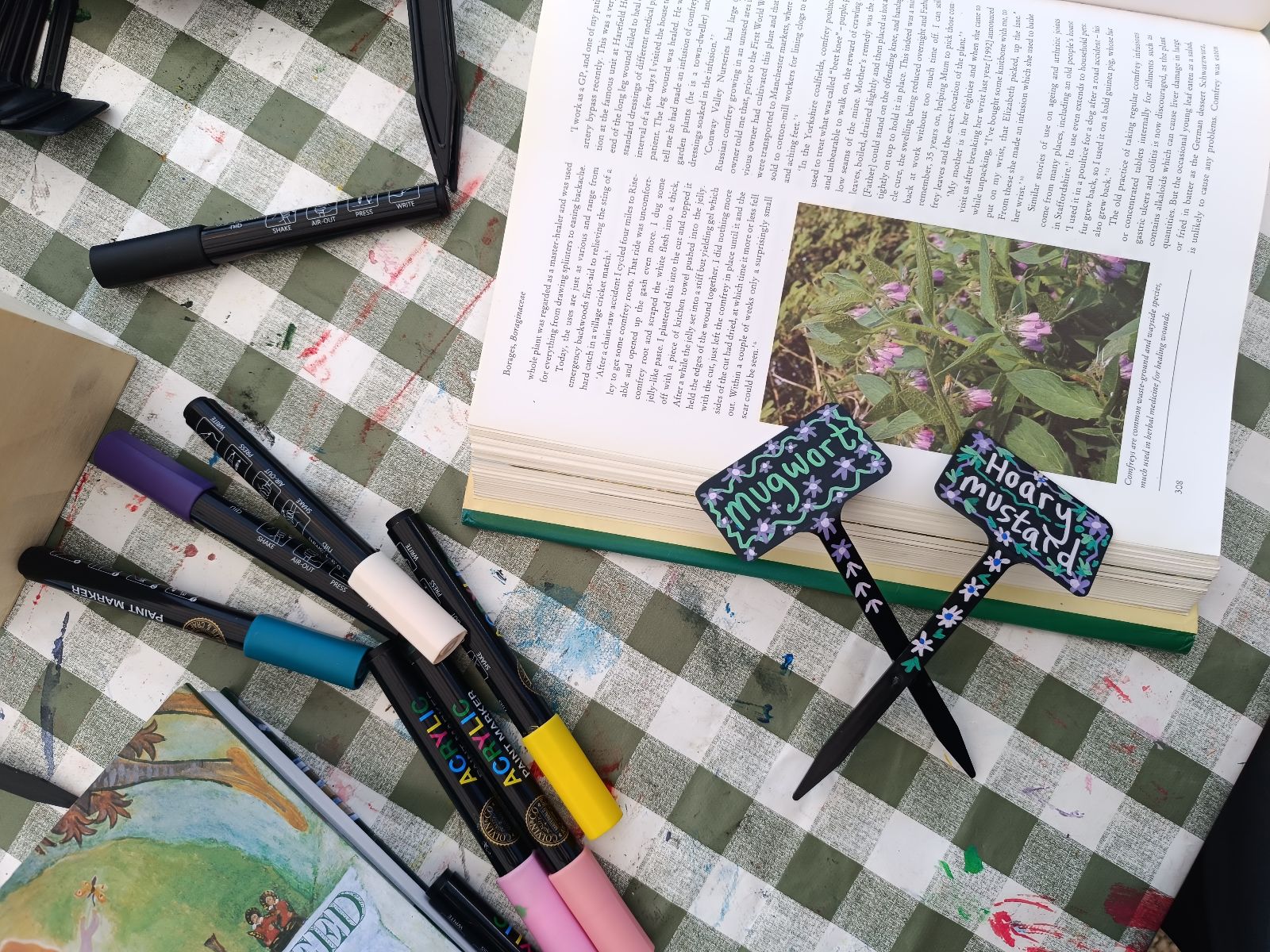
It has been sitting with a stack of identification books and the bible of plant stories, Richard Mabey’s ‘Flora Botanica’. Rediscovering a knowledge that was common and learning the uses of plants we might now write off as garden pests.
I’d like to introduce two of these plants. They are utterly intertwined, so I’ll tell you about them together.
The first is Lactic serriola also called prickly lettuce, milk thistle, compass plant, milk grass, butter weed, hwylaeth bigog.
The second is Lactic virosa also called opium lettuce, devil’s ironweed, bitter lettuce, tall lettuce, great lettuce, rakutu-karyumu-so.

I read once that the more common names a plant has, the more relationships humans have formed with it. These plants have certainly had a long and storied relationship with us and that’s seen in their names.
They are very similar plants, with the main difference being the height. Serriola is shorter and has more spines, including an extra line on the mid rib of the leaf’s undersides.
Both plants are waxy grey green with leaves that have white veins on the undersides. The veins, stems, and leaves coated in fine spines. They have delicate yellow flowers which turn into a dandelion-like clock, with large black seeds at the base. They emit latex when cut, which is why some of their common names reference milk. The latin name Lactuca refers to the latin word for milk (lac).
They are commonly referred to as a compass plant, as the upper leaves twist around the plant, pointing roughly either south or north from the stem.
Another clue to its history is the word lettuce. These plants are in fact wild ancestors of cultivated lettuce – Lactuca sativa! Wild lettuce plants were first domesticated not for their leaves but for their large black seeds, which were harvested and pressed to extract oil. The first depictions of this type of lettuce cultivation are from 2680 BC Ancient Egypt. It was much later at around 500 BC in Southern Europe cultivation began to remove the bitterness and spines and make it the leafy vegetable we eat today.
Wild lettuce was not only a food source but also a valuable medicine. The Ancient Greeks believed the juice of the plant was a remedy for eye issues. After their accidental introduction to North America, the Navajo began to use lettuce as a ceremonial emetic. They have also been used for centuries as a sedative and pain killer. In fact, the latex of the lettuce plants contain actucatium, a substance which has some similarities to opium, albeit a much milder version. There is currently scientific study further investigating the usefulness of this compound for new pain medication!
Wild lettuce is still widely eaten around the world. One example is the Greek folk recipe hortapita, meaning wild weeds pie. Its bitterness is an integral part of the flavour profile. Because Serriola is spinier, Virosa is usually more widely eaten with young stems and leaves eaten raw in salads or lightly sautéed.
We are surrounded by our shared cultural and botanical history and I’m excited to continue to uncover and share what I learn about the plants around us. So next time you see a wild lettuce, maybe share a little of what you’ve learned here, or notice it and greet it by name.
